Chapter 01
The decision inside the drought
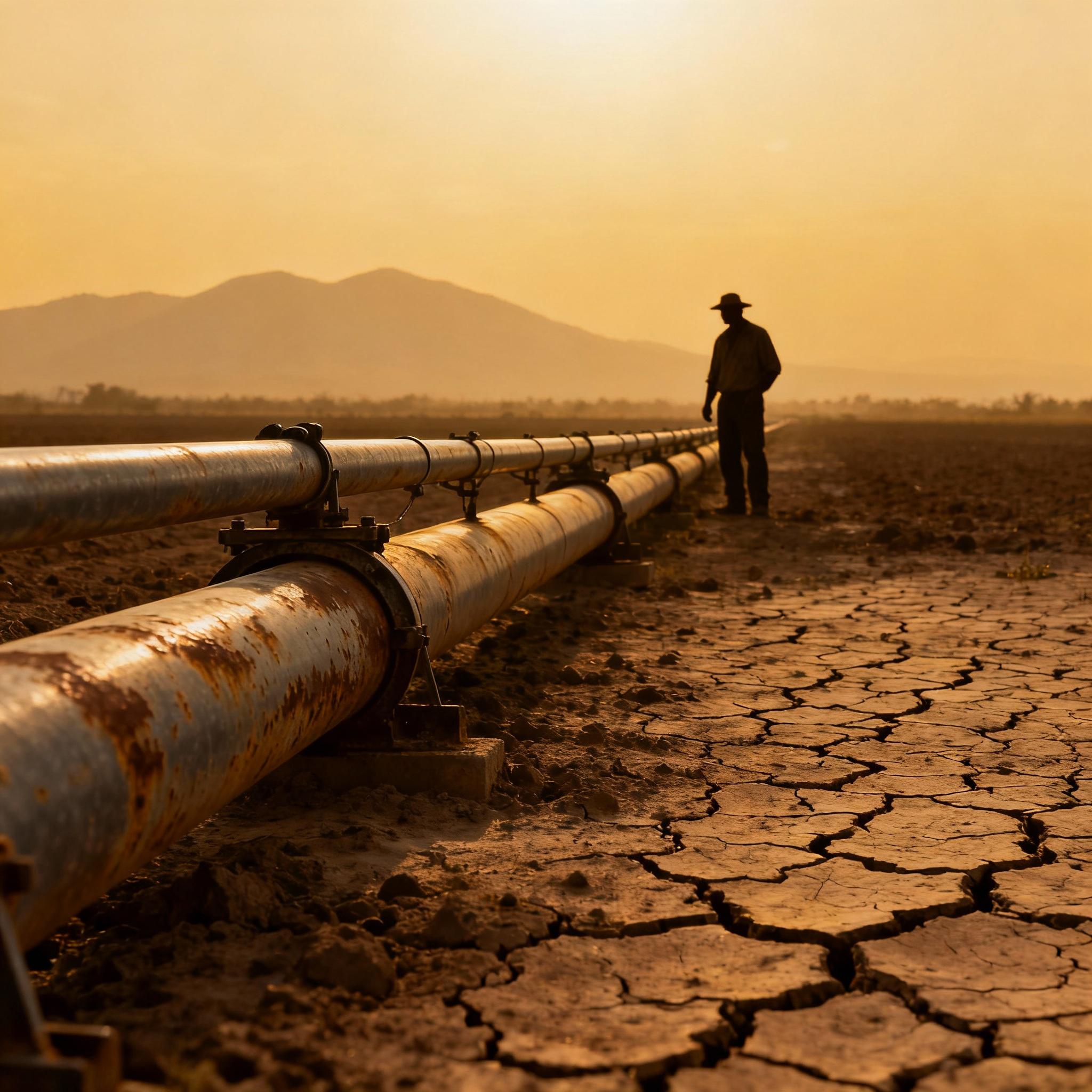
Water scarcity is planetary; irrigation happens field by field. That difference in scale is where Jairo Trad found a company. In Argentina, drought made the consequences impossible to ignore, but a farmer still had to answer an immediate question: how much water should this crop receive today? The answer was often shaped by habit, a general rule, visible stress or the understandable fear of applying too little. When the cost of under-watering can be a failed harvest, caution frequently means more water.
Trad, a computer engineer and data-science specialist from Córdoba, approached the problem as a decision system. Waste was not necessarily evidence that farmers did not care. It could be evidence that the information available at the decisive moment was weak. Kilimo began in 2014 around a modest but powerful intervention: make the condition of a crop and its water demand more legible before irrigation starts.
Chapter 02
Four disciplines at one table
Kilimo was not the work of a lone programmer discovering agriculture from a screen. Trad co-founded the company with computer engineer Juan Carlos Abdala, agricultural engineer Rodrigo Tissera and communications specialist Tatiana Malvasio. The combination mattered. A model could be technically elegant and agronomically useless. A sound recommendation could still fail if it arrived in language, timing or a workflow that a producer would not trust.
Early reporting places Trad and Abdala in contact with Tissera while he was working on irrigation management at INTA Manfredi in Córdoba. The meeting joined software capability to field knowledge. That pattern became part of Kilimo's operating logic: remote sensing can extend observation, but adoption is local. The company would need equations, agronomy, product design and long-term relationships with the people who actually open and close the water.
Chapter 03
From weather to a field-level recommendation
An irrigation recommendation sits on top of several kinds of evidence. Weather influences evaporation and plant demand. Satellite imagery helps observe crop conditions across large areas. Soil and crop characteristics affect how water is retained and used. Historical irrigation patterns provide a baseline. Kilimo combines these signals to estimate water need and deliver a programme for a particular plot rather than a generic instruction for an entire region.
The interface may look simple because the complexity has been moved behind it. Microsoft's 2025 customer study describes Kilimo collecting meteorological data, soil-moisture information and satellite imagery, and using historical analysis to estimate prior irrigation even before direct interaction with a farm. The important output is not a dashboard full of data. It is a recommendation a farmer can act on, accompanied by enough explanation and field support to earn confidence.
Chapter 04
Why precision is not enough
Precision agriculture is often sold through efficiency: use fewer inputs, reduce cost, protect yield. That proposition can work when saved water has an obvious financial value to the producer. But water pricing and rights vary, energy costs differ, and the benefit of leaving water in a watershed may be dispersed across communities. A farmer can create public value without capturing enough private value to pay for the transition.
Kilimo's strategic evolution addressed that mismatch. Instead of relying only on farmers to purchase software, it connected water-security commitments from companies with projects that help agricultural producers conserve water in the same basin. The corporate participant finances an intervention and receives quantified water benefits; the farmer receives technology, agronomic support and an incentive to change practice. The product became not only irrigation intelligence, but a mechanism for coordinating who pays.
Chapter 05
The watershed changes the unit of work
Carbon can be discussed as a global atmospheric stock. Water is stubbornly local. Saving a cubic metre in a wet basin does not repair scarcity in a dry one. Timing matters, downstream users matter, groundwater and surface flows interact, and an intervention can shift rather than eliminate consumption. Kilimo's current language—water stewardship, basin by basin—recognizes that a credible project must begin with hydrology and territory, not a generic offset claim.
This changes the work. Teams must identify priority basins, understand agricultural systems, recruit local partners and producers, establish a defensible baseline, support a practice change and measure the result. Kilimo says it expresses outcomes in cubic metres and aligns measurement with international frameworks. The move from an app to a basin programme makes the business harder to scale mechanically. It also makes the claimed impact more meaningful if the methodology withstands scrutiny.
Chapter 06
The Maipo basin test
Chile's Maipo River basin supplies drinking water and agriculture around Santiago and has endured sustained pressure. Google and the Bonneville Environmental Foundation engaged Kilimo as an implementation partner in a precision-irrigation initiative there. Google's environmental reporting described a project using AI-supported irrigation across farmland to reduce demand while maintaining or improving agricultural productivity and protecting water resources.
The partnership illustrates the full chain Kilimo is trying to build. A global company has a location-specific replenishment goal. A basin has a measurable water problem. Farmers control a large share of consumptive decisions. Kilimo supplies the technical and field layer that can translate corporate funding into changed agricultural practice. Each link can fail: a weak baseline inflates savings, poor adoption makes recommendations theoretical, and distant corporate claims can outrun local benefit. The value is in making the chain auditable.
Chapter 07
Scale measured in trust
The World Economic Forum's current profile says Kilimo operates across more than seven countries and has worked with companies including Google, Microsoft, Amazon and Coca-Cola. The company reports thousands of farmers and billions of litres saved; its own site now states more than eight million cubic metres restored. These are significant claims, but they are not self-proving. Water accounting depends on counterfactuals: what would have happened without the intervention?
That uncertainty does not make measurement pointless. It defines the standard required. A serious programme needs transparent methods, conservative assumptions, monitoring over time and clarity about whether a number represents reduced withdrawal, reduced consumption, replenishment or another benefit. Kilimo's future authority will come less from the size of a headline than from whether independent partners, producers and watershed stakeholders can follow the evidence beneath it.
Chapter 08
The farmer is not a sensor
Climate technology can become extractive when it treats the producer as a source of data and the field as a remote optimization surface. Kilimo's better instinct is visible in its emphasis on territorial intelligence and field implementation. A farmer knows equipment limits, crop risk, labour constraints and anomalies that satellite imagery cannot infer reliably. The recommendation becomes useful when it enters that existing knowledge system rather than attempting to replace it.
Adoption also has a time horizon. A single season of subsidized technology may produce a report; sustained practice can change a basin. That means incentives must survive after a pilot, the interface must remain understandable, and reported savings must not depend on permanent outside hand-holding. The company's deepest product is therefore behavioural and institutional as much as computational: confidence that a lower-water decision will not sacrifice the livelihood attached to the crop.
Chapter 09
A new market, and its dangers
Paying farmers for water benefits creates a market where none was visible before. It recognizes that agricultural efficiency can serve cities, ecosystems and industrial users and that the producer doing the work deserves a share of the value. It can direct corporate sustainability budgets toward measurable local action rather than distant symbolism. It can also create pressure to manufacture attractive numbers, simplify contested water rights or imply that a purchased benefit grants permission for unlimited consumption elsewhere.
Kilimo has to hold both truths. Finance can accelerate conservation, and financialization can distort it. The safeguards are specificity and restraint: same-basin relevance, clear project boundaries, credible additionality, local participation and language that distinguishes a contribution from a cure. No technology company owns the watershed. A platform can help participants coordinate, but legitimacy ultimately depends on the people and institutions that share the water.
Chapter 10
The founder's second-order insight
Trad's first insight was that irrigation waste contains an information problem. His second was that information alone does not rearrange incentives. Farmers may receive a better recommendation and still lack the capital, equipment or economic reason to act. Corporations may set replenishment targets and still lack a route to credible field projects. Kilimo moved into the gap between those two groups.
That evolution is the real company story. The original product helped decide when and how much to irrigate. The emerging platform decides how a watershed intervention is selected, financed, implemented and verified. Trad's civic-technology work in Córdoba—he also co-founded open-data initiatives—fits the same intellectual pattern: make an invisible system observable, then give people a practical way to act on what the data reveals.
Chapter 11
The record
Jairo Trad did not solve drought. Kilimo did something more bounded and therefore more credible: it identified a recurring decision inside agriculture where better evidence could reduce water demand, and it kept expanding the system until the people who benefit could help pay the people who change. That is an important form of climate entrepreneurship. It works backward from a physical outcome rather than forward from a fashionable technology.
The record should remain demanding. Count water carefully. Separate company-reported impact from independently validated results. Ask who owns the data, who receives the incentive and what happens when sponsorship ends. Then preserve what is genuinely ambitious: engineers, agronomists and field teams from Córdoba built a model now operating across the Americas because they understood that the future of water is decided in millions of local moments. Kilimo exists to make those moments measurable—and worth changing.